
The Stoic Path to Professional Development: Practicing “Arete” in Modern Work
As many of you know, I am a student of philosophy, both Eastern and ancient Greek. Both schools have much to teach us about how to act and live in disruptive times. In Stoic philosophy, Arete is often translated as “virtue” or “excellence,” but it means something deeper than achievement or status. It is the pursuit of becoming the highest version of yourself through disciplined action, self-awareness, and character. The Stoics did not measure success by titles, wealth, or recognition. They measured it by how well a person lived and responded to the world around them.
In today’s professional environment, where careers are often defined by metrics, promotions, and external validation, Stoic principles offer a remarkably practical framework for growth. The Stoics understood something modern professionals often forget: lasting development does not come from comfort, ego, or avoiding difficulty. It comes from intentional struggle and continual refinement.
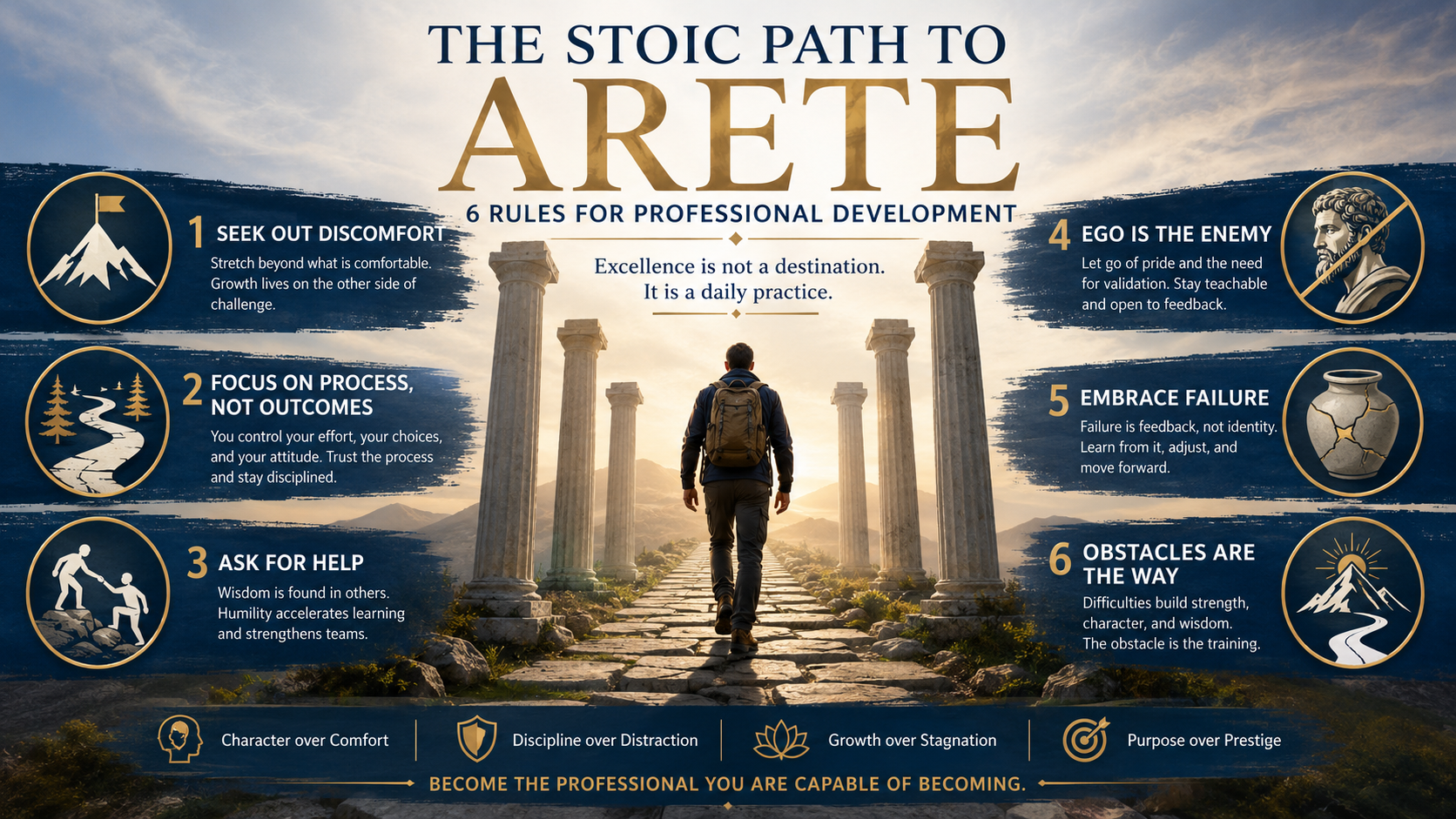
The six Stoic principles below provide a powerful model for professional development and personal mastery.
Seek Out Discomfort by Stretching Beyond What Is Comfortable
Growth rarely occurs inside familiar territory. The Stoics believed discomfort was not something to avoid but something to deliberately encounter. Voluntary hardship built resilience, discipline, and adaptability.
Professionally, this means pursuing assignments that expose weaknesses rather than reinforce strengths. It means speaking in front of groups even when public speaking feels uncomfortable. It means learning new technologies, leading projects without certainty, or stepping into roles before feeling completely prepared.
Most careers stagnate not because people lack talent, but because they become too comfortable with competence. Excellence requires continual stretching.
Discomfort is often a signal that development is happening.
The professional who embraces challenge gains confidence rooted in capability rather than convenience. Over time, difficult situations become training grounds instead of threats.
Focus on Process, Not Outcomes
Modern workplaces often obsess over outcomes: promotions, certifications, recognition, productivity metrics, or salary increases. While outcomes matter, the Stoics warned against tying personal worth to things outside one’s complete control.
A Stoic approach focuses instead on the quality of the process:
Did you prepare thoroughly?
Did you act with discipline?
Did you improve your craft?
Did you conduct yourself with integrity?
Outcomes are influenced by countless external factors. Process is where personal agency lives.
Professionals who focus only on outcomes often become discouraged when progress is slow or recognition is delayed. Those who focus on process continue improving regardless of immediate rewards.
Ironically, consistent attention to process usually produces better outcomes over time.
A surveyor refining field procedures, a GIS analyst improving data accuracy, or a project manager strengthening communication habits may not see immediate rewards. But incremental excellence compounds. Small disciplines practiced consistently become professional mastery.
Ask for Help
One of the great misconceptions about professional competence is the belief that capable people should already know the answers. Stoicism rejects this kind of pride.
The Stoics valued wisdom above appearance. Wisdom requires recognizing limitations and learning from others.
Asking for help is not weakness. It is intellectual humility.
In professional environments, those who refuse assistance often slow their own development. They waste energy protecting appearances instead of acquiring knowledge. Meanwhile, professionals who actively seek mentorship, feedback, and collaboration accelerate their growth.
No one masters a profession alone.
Experienced professionals carry institutional knowledge, technical insight, and lessons learned through failure. Seeking guidance shortens learning curves and prevents avoidable mistakes.
More importantly, asking questions demonstrates commitment to improvement rather than attachment to ego.
Ego Is the Enemy
Ego is one of the greatest obstacles to professional growth because it resists correction. It seeks validation instead of truth.
The Stoics emphasized self-awareness and humility because they understood that ego blinds people to their weaknesses. Professionals driven by ego often:
Defend mistakes instead of learning from them
Resist feedback
Overestimate their abilities
Compete unnecessarily
Seek credit more than contribution
True confidence is quiet. It does not require constant recognition.
In professional development, humility creates adaptability. It allows people to change methods, update assumptions, and continuously learn. Industries evolve. Technology changes. Standards shift. Professionals attached to “the way things have always been done” often fall behind because ego prevents reinvention.
The best professionals remain students regardless of experience level.
They understand that mastery is not a destination but a continual process of refinement.
Embrace Failure
Failure is unavoidable in meaningful work. Projects collapse. Mistakes happen. Decisions prove incorrect. New systems fail. Plans do not unfold as expected.
The Stoics taught that failure itself is not destructive; the interpretation of failure is what matters.
Professionally, failure becomes valuable when treated as feedback instead of identity.
Every setback contains information:
What assumption proved incorrect?
What process failed?
What skill needs improvement?
What blind spot became visible?
Professionals who fear failure often avoid risk, innovation, and growth opportunities. They remain trapped in safe routines that preserve comfort but limit advancement.
Those who embrace failure develop resilience and adaptability. They become less emotionally attached to perfection and more committed to continual improvement.
The most experienced professionals are rarely those who avoided mistakes. They are usually the ones who survived, analyzed, and learned from them.
Obstacles Are the Way
Perhaps the most practical Stoic principle is the idea that obstacles are not interruptions to the path — they are the path.
Difficult coworkers, tight deadlines, changing technology, budget limitations, regulatory complexity, and unexpected setbacks are not deviations from professional development. They are the very conditions through which growth occurs.
Patience develops through delays.
Leadership develops through conflict.
Adaptability develops through uncertainty.
Discipline develops through difficulty.
Without obstacles, many professional virtues would never emerge.
This mindset fundamentally changes how challenges are perceived. Instead of asking, “Why is this happening to me?” the Stoic asks, “What is this situation training me to become?”
Obstacles transform from frustrations into opportunities for refinement.
Excellence as a Daily Practice
The Stoics viewed Arete not as perfection, but as continual progress toward excellence in thought, action, and character. Professional development works the same way.
Careers are not built through isolated moments of success. They are shaped through repeated choices:
choosing challenge over comfort,
discipline over distraction,
humility over ego,
learning over defensiveness,
persistence over discouragement.
In an era focused heavily on external achievement, Stoicism reminds us that the most important professional development occurs internally. Technical skill matters, but character determines how consistently and effectively those skills are applied.
The pursuit of Arete is ultimately the pursuit of becoming someone capable of handling responsibility, adversity, and success with wisdom and discipline.
And in professional life, that may be the highest form of excellence possible.