

Leadership and Mentoring in Surveying and GIS: How Technology Has Changed the Way We Develop the Next Generation
For generations, the surveying and GIS professions have been built upon one of the oldest forms of education: apprenticeship. While colleges and technical schools have always provided important theoretical foundations, much of what makes an exceptional surveyor or GIS professional has traditionally been learned by working alongside experienced practitioners. Young technicians accompanied seasoned surveyors into the field, watched them recover monuments, observed how they resolved conflicting evidence, and learned the reasoning behind decisions that could never be fully captured in textbooks. Likewise, new GIS technicians sat beside experienced parcel mappers, observing how legal descriptions were interpreted, how difficult boundary problems were solved, and how experienced professionals balanced legal intent with technical precision.
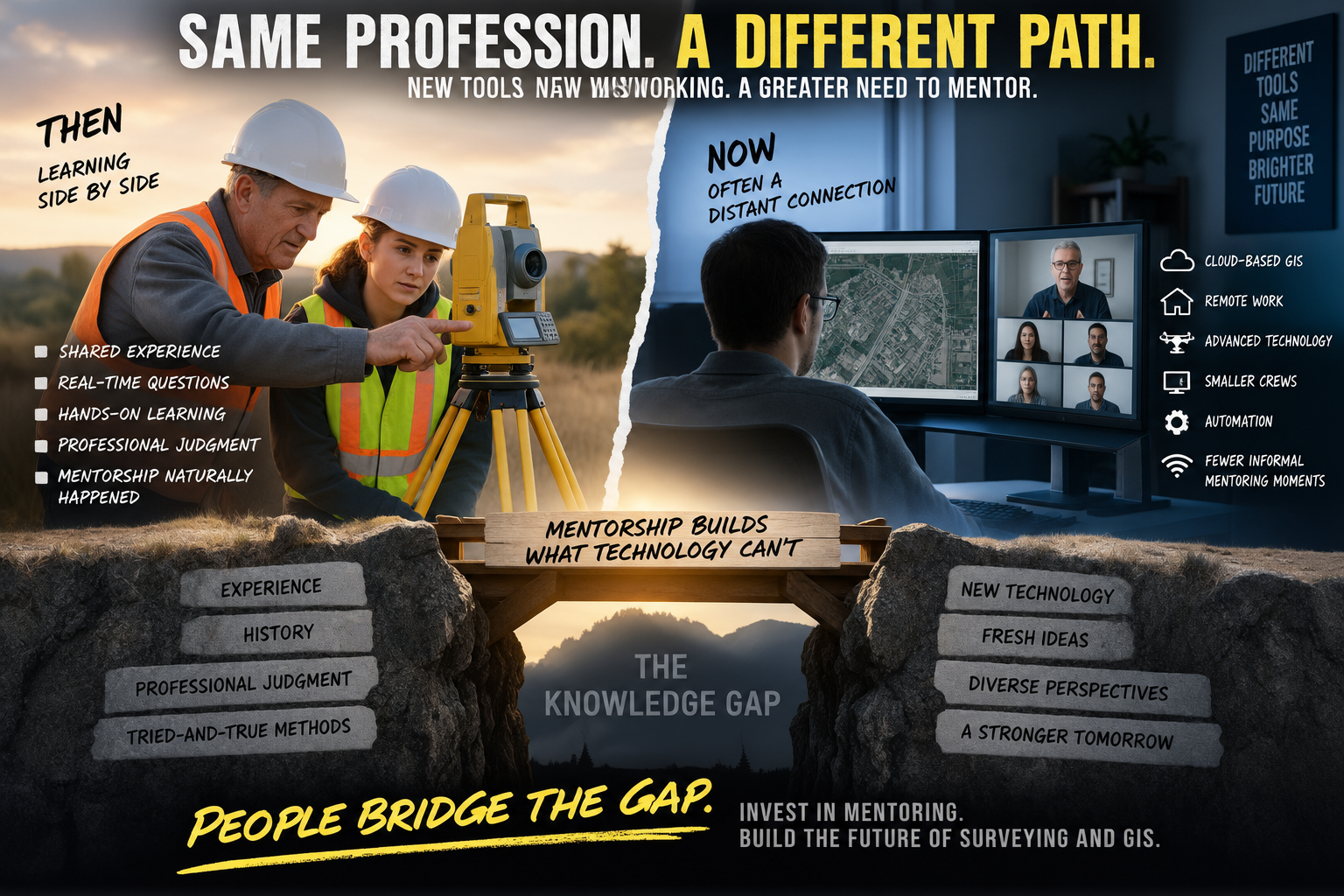
Today, however, the professions are experiencing a profound shift. Advances in technology have transformed how surveying and GIS work is performed, but they have also fundamentally altered how knowledge is transferred from one generation to the next. While technological innovation has improved productivity, accuracy, and collaboration, it has also created new challenges for leadership, mentoring, and professional development.
The question facing today's organizations is no longer simply how to leverage new technology. It is how to preserve decades of institutional knowledge while preparing a new generation of professionals who may never experience the traditional mentorship model that shaped the industry's greatest leaders.
The Traditional Model of Mentorship
For much of the twentieth century, mentorship occurred naturally.
A young survey technician rarely worked alone. Every day was spent with licensed surveyors who explained not only what they were doing, but why they were doing it. Conversations occurred while driving between job sites, walking section lines, setting monuments, or reviewing plats back in the office.
These moments created continuous opportunities for learning.
Experienced professionals would ask questions rather than simply provide answers.
"What evidence would you trust?"
"Why do you think this monument controls over that deed call?"
"How would this affect adjoining properties?"
The same was true in GIS.
Early parcel mappers often worked in close proximity to one another. Questions could be asked across the room. Difficult legal descriptions became collaborative discussions. New employees overheard conversations involving title issues, subdivision interpretations, coordinate geometry, and quality control. Learning was constant because experienced professionals were physically present.
Mentorship was not scheduled.
It happened every day.
Technology Has Changed the Workplace
Modern technology has unquestionably made surveying and GIS more efficient.
Today's professionals utilize:
Cloud-hosted GIS
ArcGIS Enterprise
ArcGIS Online
Parcel Fabric
Real-time collaboration
GNSS and RTK positioning
Robotic total stations
Mobile LiDAR
UAV photogrammetry
Mobile field applications
AI-assisted workflows
Automated quality assurance
Field crews have become dramatically smaller.
Many organizations that once deployed three- or four-person crews now operate efficiently with one or two individuals. Experienced crew chiefs often work independently for days without direct interaction with younger employees.
Similarly, GIS departments have embraced cloud computing, virtual private networks, and remote work environments that allow staff members to perform nearly all mapping functions from home.
While these technologies increase flexibility and productivity, they also reduce one critical element:
Human interaction.
The Loss of Informal Learning
One of the greatest casualties of remote work is informal mentoring.
In traditional offices, junior staff members overheard conversations that were never intended as lessons but became invaluable educational experiences.
A senior mapper discussing a difficult deed interpretation with another professional could unintentionally educate everyone within earshot.
A surveyor returning from the field with an unusual monument might gather several coworkers to discuss its significance.
These spontaneous learning moments rarely occur in virtual environments.
Video meetings tend to focus on specific agendas.
Instant messaging encourages quick answers rather than extended discussion.
Many employees simply complete assigned tasks without exposure to the broader reasoning behind decisions.
The result is a workforce that becomes technically proficient yet may lack the judgment that only develops through repeated observation of experienced professionals.
Leadership Is Becoming More Intentional
Because informal mentoring has diminished, leadership must become intentional.
Organizations can no longer assume that knowledge will naturally transfer from senior staff to junior employees.
Instead, leaders must deliberately create opportunities for mentoring.
This may include:
Weekly technical review sessions
Case-study discussions
Shared problem-solving meetings
Recorded demonstrations
Virtual office hours
Cross-disciplinary project reviews
Shadowing opportunities
Field rotations
The best leaders today recognize that technical expertise alone does not create future leaders.
Teaching does.
Technology Has Also Changed Leadership
Leadership itself has evolved.
Historically, supervisors often measured productivity by observing employees at their desks or in the field.
Remote work has shifted the focus toward outcomes rather than physical presence.
Successful leaders now emphasize:
Communication
Trust
Accountability
Documentation
Collaboration
Emotional intelligence
Coaching rather than directing
Managing distributed teams requires different skills than managing employees working in the same building.
Leaders must intentionally check in with employees who may otherwise become isolated.
Recognition, encouragement, and constructive feedback become even more important when people work remotely.
Institutional Knowledge Is Retiring
Perhaps the greatest challenge facing surveying and GIS is the retirement of experienced professionals.
Many senior surveyors possess forty or fifty years of practical knowledge.
They have witnessed boundary disputes, courthouse fires, changing laws, multiple generations of subdivision development, and evolving mapping technologies.
Much of this knowledge exists nowhere except in their experience.
When these professionals retire, organizations often lose:
Historical context
Local surveying practices
Relationships with neighboring jurisdictions
Knowledge of long-standing boundary issues
Understanding of legacy datasets
Practical decision-making skills
Technology cannot replace these experiences.
Artificial intelligence can summarize documents.
It cannot replace decades of professional judgment developed through thousands of real-world decisions.
The Role of AI
Artificial intelligence is rapidly becoming another valuable tool.
AI can assist with:
Code generation
Documentation
Data validation
Workflow automation
Image recognition
Feature extraction
Report preparation
Yet AI cannot mentor.
It cannot explain why one monument controls another.
It cannot teach professional ethics through lived experience.
It cannot model leadership during difficult conversations with clients or coworkers.
Nor can it replace the confidence that develops when an experienced professional says,
"Let's work through this together."
Rather than replacing mentors, AI should free experienced professionals from repetitive tasks, allowing them to spend more time teaching others.
Creating the Next Generation of Leaders
Leadership development should begin long before someone becomes a supervisor.
Young professionals need opportunities to:
Lead small projects
Present technical findings
Mentor interns
Participate in strategic planning
Facilitate meetings
Develop communication skills
Learn budgeting and project management
Leadership is developed through practice.
Waiting until someone receives a management title is often too late.
Organizations that intentionally cultivate leadership throughout employees' careers will be better positioned to navigate future technological change.
Building a Culture of Continuous Learning
Technology will continue to evolve.
Tomorrow's professionals will undoubtedly work with tools that seem unimaginable today.
However, one principle will remain unchanged.
Surveying and GIS are professions built on judgment.
Judgment is developed through experience.
Experience is accelerated through mentorship.
Organizations should encourage continuous learning by fostering environments where asking questions is viewed as a strength rather than a weakness. Senior staff should be recognized not only for their technical expertise but also for their willingness to teach. Likewise, younger professionals should be encouraged to share new technological skills with experienced staff, creating a two-way exchange of knowledge. This reciprocal mentoring model benefits everyone. Veteran professionals contribute historical context, legal reasoning, and practical wisdom, while newer employees often introduce innovative workflows, automation techniques, and emerging technologies that improve efficiency.
Looking Forward
The surveying and GIS professions have always adapted to technological change. We have transitioned from steel tapes to GNSS, from paper maps to digital twins, from manual drafting to intelligent geospatial databases, and from desktop software to cloud-based platforms. Each advancement has improved the way we collect, manage, and share spatial information.
The next challenge is not technological—it is cultural.
As organizations embrace hybrid and remote work environments, they must also rethink how they develop people. Leadership can no longer rely on chance encounters in the office or informal conversations in the field. Mentorship must become a deliberate investment, supported by structured learning opportunities, open communication, and a commitment to preserving institutional knowledge before it disappears.
Ultimately, the future of surveying and GIS will not be determined solely by faster instruments, smarter software, or artificial intelligence. It will be shaped by the professionals who choose to invest in others, share what they know, and prepare the next generation to solve problems that have yet to emerge. Technology will continue to change, but leadership and mentorship will remain the enduring foundations upon which these professions are built.