

Exploring First Principles of Parcels
I have been experimenting recently with various ways to explain to others why parcels are inherently complex, and recently began exploring using the First Principles technique/
First principles thinking means refusing to just trust what you've been told is true. Instead of accepting the way a field has always done things — its standard tools, its go-to answers, its unquestioned habits — you strip everything back to what you can actually prove yourself, and rebuild from there. The philosopher Descartes made this famous, but the instinct is older: if you can't verify something from scratch, you don't really know it — you've just borrowed someone else's conclusion. When you apply this to any technical subject, it means hunting down every hidden assumption, asking which ones are actually proven rather than just "how we've always done it," and being honest when the answer is that much of the foundation is shakier than it looked.
What this process changes isn't always the final answer — it's what you can see. Most inherited knowledge is genuinely useful. Experts compress decades of hard experience into tools and shortcuts, and those tools mostly work. But that compression hides things: the uncertainty, the edge cases, the political choices, the moments where someone made a judgment call and everyone downstream just accepted it. First principles analysis doesn't usually burn the whole field down. It shows you what the tools actually are, versus what they imply. The coordinate is still useful. The map is still useful. But now you know you're working with a model of reality, not reality itself — and that shift, from borrowed confidence to something you actually understand, is the whole point.
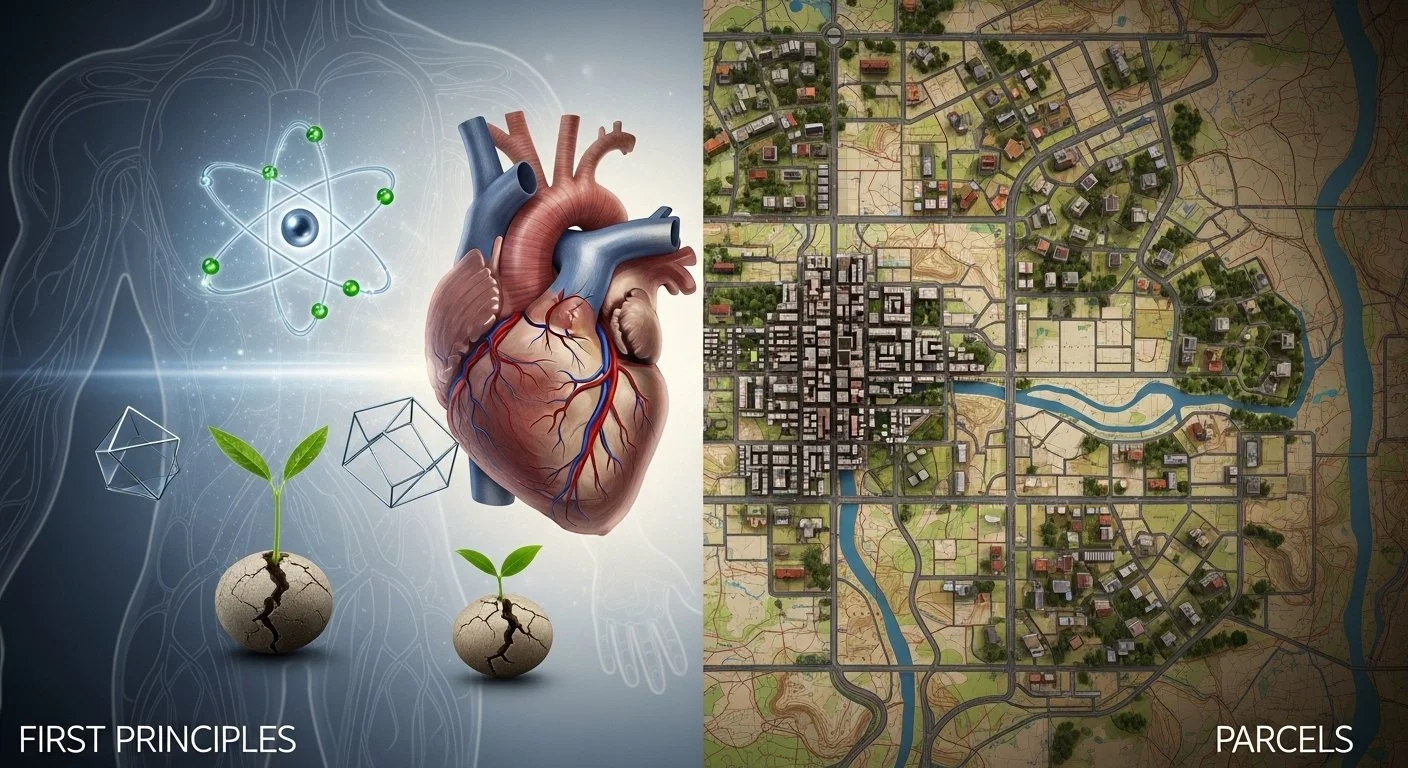
What parcel mapping gets wrong — and what's actually true underneath
Most people learning GIS for the first time do the same thing: open the software, load the map layer, run a query. The land parcels on screen look official. The data table looks complete. The whole system feels solid and trustworthy.
But it isn't — not entirely. Underneath that clean interface, parcel mapping is built on a set of assumptions so widely shared that nobody questions them anymore. They've stopped feeling like assumptions and started feeling like facts. This piece strips them away one by one and asks what's actually, provably true underneath — then looks at what the field would look like if it were built honestly from scratch.
The assumptions nobody mentions
Before you can question anything, you have to name what's being assumed in the first place. Here's what most practitioners silently accept from day one:
Parcels are real, objective things that exist in the world. The edge of a parcel is a line. Each parcel has one owner. Coordinates on a map are ground truth. The map is a neutral, unbiased record of reality. The shape data and the ownership data are separate things. The current map reflects what actually happened historically. Parcels cover all land with no gaps. You either own land or you don't. A parcel exists in two dimensions.
Every single one of these is worth questioning. Some turn out to be just wrong.
What survives when you strip them away
Parcels are objective facts. Not quite. What actually exists is a legal document — a deed, a title, a court record — that describes a claim. The parcel on the map is someone's interpretation of that document, translated into a shape. The document is the real thing. The polygon is a model of it. When they disagree, which happens more often than you'd think, the document wins. That's not a technicality — it's actual property law.
Boundaries are lines. A boundary line on a map is a model of an agreement between people. That agreement might reference a river (which moves over time), a fence (which was built by someone eyeballing it), a stone marker (which got dug up and moved), or a written description that says something like "go north until you reach the old Miller property." Turning that into a precise coordinate is someone's best guess. The line on screen looks exact. The thing it's representing often isn't.
One parcel, one owner. The OWNER field in any parcel database trains you to think ownership is one simple thing. It isn't. The same piece of land can have a family who owns the surface, a utility company with a legal right to run pipes underneath, a bank holding a mortgage, a neighbor with a legal right to cross the corner, and a decades-old restriction that prevents anyone from ever building on it. The database shows you one name. The legal reality has a whole stack of different rights held by different people simultaneously.
Coordinates are ground truth. The deed is ground truth. Coordinates are what you get when someone tries to translate the deed's description into map positions. An old property description that says "from the creek, forty rods east" — turned into GPS coordinates in a modern GIS — looks incredibly precise on screen. But the precision is in the computer. The original description was vague. High precision and high accuracy are two different things, and parcel maps often have one without the other.
The map is a neutral record. Every land ownership map reflects decisions made by the people and governments who built it. In the US, the federal survey grid was drawn across land that indigenous people already occupied, turning it into sellable plots before most of that displacement happened. Maps in former colonies drew boundaries for administrative convenience, not to reflect how communities actually organized themselves. Legal land rights that exist under current law — like native title in Australia — often don't appear on cadastral maps at all. A map doesn't just record reality. It decides which claims count.
The cadastre reflects history. It reflects which claims the government chose to formalize. That's a narrower thing. Plenty of real, legally valid history doesn't make it onto the map.
Parcels tile continuously. Open any real parcel dataset and you'll find gaps — slivers between parcels where the geometry doesn't quite connect, roads that aren't parcels, public land registered differently, and in many parts of the world, large areas of land used and occupied by communities but never entered into the formal system. Empty space on the map doesn't mean nobody has rights there. It means the system has no record. Those are very different statements.
Ownership is binary. See above. It's a stack of different rights, and multiple people can hold different layers of that stack at the same time.
Parcels are 2D. Works fine for a house on a flat lot. Falls apart for a condominium (your apartment is on the fourth floor — the ground-level polygon tells you almost nothing), a mine (the valuable thing is underground), or an air rights deal where someone has legally purchased the right to build above a railway line. The flat polygon was designed for the simple case and quietly applied to everything.
What's left after stripping everything
Once every inherited assumption is removed, what can you actually prove?
Human institutions create bounded claims over portions of the earth. Those claims change over time. They stack — multiple rights, multiple holders, multiple purposes, all on the same ground. And the geometry used to represent them carries hidden uncertainty that the precision of coordinates actively conceals.
That's the bedrock. Everything else in parcel mapping is infrastructure built on top of those four facts.
What an honest system looks like
The data model changes. A flat table with one row per parcel, one shape, one owner field — that can't represent what's actually true. An honest system needs at minimum: a claims table (the legal right is the core object, not the polygon), a geometry table that can hold multiple representations of the same claim over time, a rights table that captures the full stack of who holds what, and an uncertainty field on every boundary segment that says how confident we actually are in that line's position.
The questions you can ask change. "Who owns this parcel?" becomes "who holds which rights here, as of what date, according to which institution?" That's more complicated to answer — but it's the question that actually matters when you're doing a tax assessment, approving a development permit, routing infrastructure, or trying to figure out who to compensate before building a road.
Precision stops masking accuracy problems. A coordinate with eight decimal places looks authoritative. First principles force you to ask separately: how precise is this geometry, and how accurately does it reflect the legal boundary? Those are different questions with different answers, and conflating them produces confident-looking results built on uncertain ground.
The map stops pretending to be neutral. Every analytical layer built on parcel data inherits the politics of whoever built that cadastre — whose claims they recorded, whose they skipped, and how carefully they surveyed different neighborhoods. An honest system makes that visible rather than hiding it inside a clean-looking polygon fill.
Time becomes a first-class concern. Land claims aren't static objects. They're snapshots of agreements at moments in time. A real system tracks the full history: when boundaries shifted, when rights changed hands, when disputes were resolved. Not a "last updated" timestamp on a flat record — a versioned timeline of every change, queryable at any point.
The honest bottom line
GIS software is genuinely excellent at working with geometry — storing it, measuring it, displaying it, and analyzing it. That capability is real and worth having. The gap isn't in the tools. It's that parcel mapping inherited an institutional framework — the cadastre, the tradition of land registration — without inheriting the honesty about what that framework can and can't represent.
The polygon looks like a fact. The OWNER field appears to be a fact. The query result appears to be a fact. But they're models of legal claims, built from interpreted documents, carrying hidden uncertainty, and shaped by choices about whose rights were written down and whose weren't.
That doesn't make the data useless. It makes knowing what the data actually is the most important thing, because the only kind of useful that holds up under pressure is the honest kind.
If you wish to explore these concepts further, please feel free to review a new First Principles section on our website